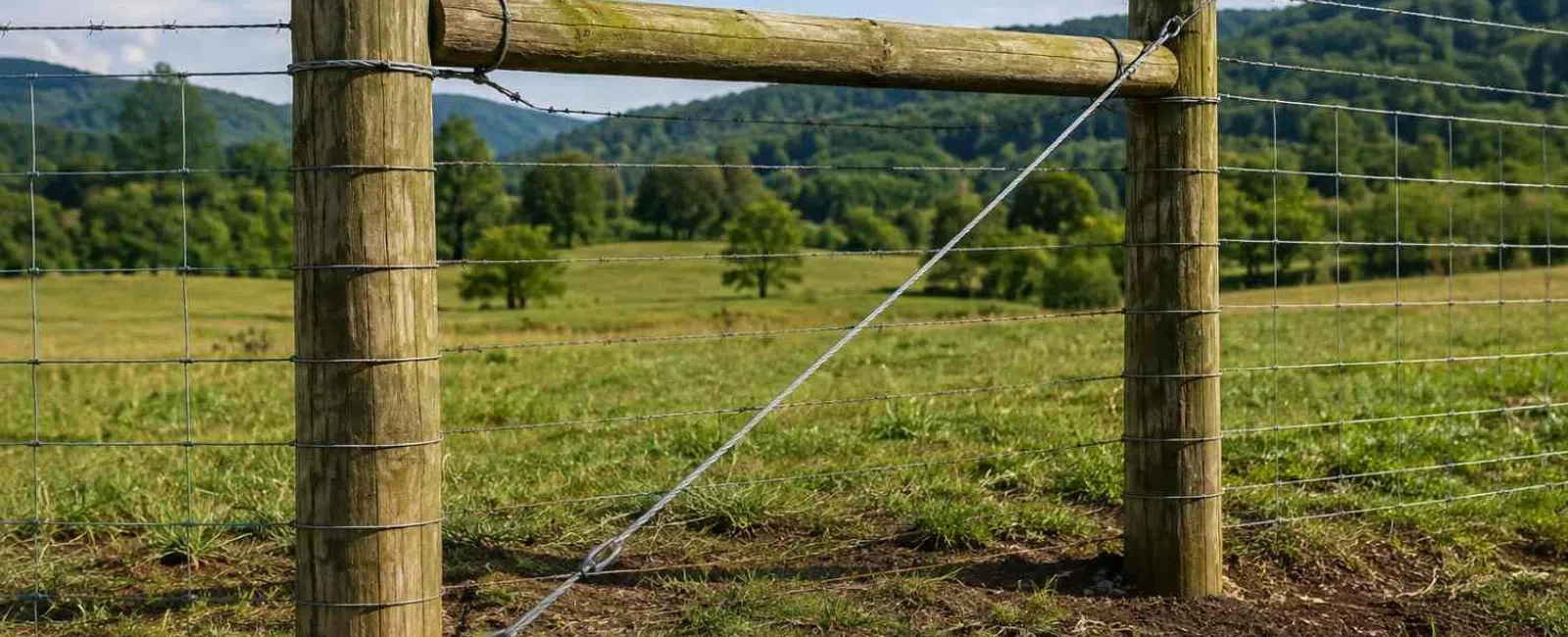
Proper corner bracing is one of the most important parts of a strong, long-lasting fence. While line posts support the wire along the fence, corner and end posts handle the tension created when the wire is stretched. Without adequate bracing, that constant pressure can cause corner posts to lean, wires to loosen, and sections of the fence to lose their effectiveness over time.
A well-built brace assembly helps distribute that tension and keeps the fence stable. Many problems with farm fencing can be traced back to weak or improperly built corners, which is why choosing the right posts, brace design, and installation method matters from the start.
The Corner Carries the Entire Run
Tension does
not distribute evenly. A line post carries almost nothing horizontally, because
the wire pulls equally hard in both directions and the forces cancel. At a corner,
an end, or a gate opening, nothing pulls back. The full tension of every strand
lands on that one post as a rotating force. That is why depth alone never saves
a corner. A post set straight in the ground is a lever with its fulcrum at the
soil surface. The brace converts that tipping force into compression spread
across two or three posts, which soil can resist.
Building the H-Brace, Component by Component
The Corner Post
Eight inches in
diameter is the working minimum for a cattle fence corner, and larger is better
on long pulls or heavy woven wire. Set it three and a half to four feet deep
and tamp in layers, six inches at a time, harder than feels necessary. A post
backfilled loose in one dump will move.
Concrete is not
the answer most people think it is. A collar around a wood post creates a
bathtub that holds water against the wood, and the post rots at the ground line
where you cannot see it. Tamped soil and gravel drains and outperforms it in
most ground.
The Brace Rail
The rail is
where the assembly is usually undersized. It should span at least two and a
half times the height of the fence. On a fifty-four-inch woven wire fence, that means roughly eleven feet between post centers, not the six- or seven-foot rail people cut because it was on the trailer. A short rail gives the brace post too
little leverage, and the whole assembly rotates as one piece.
Set the rail
high, near the top of the posts, and pin it. A rail sitting in a shallow notch,
relying on the brace wire to stay put, pops out the first time the ground
heaves.
The Brace Wire
The diagonal
wire does the actual work, and it runs one direction only. It goes from the
bottom of the corner post to the top of the brace post. Wrapped that way,
twisting it tight pulls the brace post back toward the corner base and opposes
the fence pull. Run it the other way, and you have built something that helps
the fence pull your corner over.
Use a double
loop of smooth wire, nine-gauge or twelve-and-a-half-gauge high-tensile,
twisted with a brace pin. Twisting until the wire sings
compresses the assembly enough to start lifting the brace post out of the
ground.
Choosing the Assembly for the Ground You Have
There is no
single correct brace, only the correct brace for the soil, the pull, and the
direction of the load.
|
Brace type |
Where it belongs |
How it is built |
Weak point |
|
Single H-brace |
Standard corners, gates, and ends on runs up to about 660
feet of firm ground |
Corner post plus one brace post, joined by a horizontal
rail with a twisted diagonal brace wire |
Undersized posts, or a rail set too short to spread the
load |
|
Double H-brace |
Long pulls, heavy
woven wire, and any corner taking tension from two directions |
Two braced spans in
line, sharing the pull across three posts instead of two |
Builders skip it on
long runs and the single brace slowly walks out |
|
Floating or deadman brace |
Shallow soil where the brace post cannot be set to full
depth |
The brace bears on the surface and is held down by buried
weight rather than post depth |
Needs real mass to work, and it will creep if the anchor is
light |
|
Rock pinning |
Ledge and shale,
common across much of the region |
The post is pinned
directly into bedrock with steel driven or grouted into a drilled hole |
Requires a drill and
correct hole depth, so it gets substituted with concrete instead |
|
Guy wire brace |
Ends and temporary corners where a full assembly is not
practical |
A single cable from the top of the post to a buried anchor
set back from the pull |
The anchor is the whole system, and a shallow anchor lifts
under load |
Bracing in Rock and Shallow Soil
The standard
advice assumes you can dig a four-foot hole. Across a lot of Southwest Virginia
you cannot. Hit a ledge at 18 inches on a sidehill, and every spec sheet
written for flat Midwestern ground stops being useful. The common shortcut is a
short post in a concrete plug, and it is a rigid unit with almost no resistance
to rotation. It holds through the first winter and then tips as a block.
Two approaches
work in shallow ground. Pin the post to the rock, drilling into the ledge and
setting steel so the bedrock becomes the anchor, which makes a shallow post
stronger than a deep one in dirt. Or float the brace, bearing on the surface
and holding it with buried mass rather than depth.
Either way,
know what is under you first. Getting the fence line cleared
ahead of the build shows you the outcrops and the wet spots, and lets you set
corners where they belong rather than where the brush allowed.
The Failures We Get Called Out For
- Brace rail too short, the most common defect by a wide margin and the hardest to fix after the fact.
- Brace wire wrapped backward, top of corner to bottom of brace post, loading the assembly the wrong way.
- Single H-brace where the pull called for a double, so the corner walks out over several seasons.
- Corner set in concrete without drainage, rotting at the ground line while the top still looks sound.
- Gate posts braced like line ends, ignoring the swinging weight hanging off one side.
That last one matters most at a barn lot or working pen, where the hinge post carries both fence tension and gate weight. Catching these on a yearly walk is ordinary farm upkeep. Catching them late is a rebuild.
Building New Fence, or Fixing One That Moved?
Ranch Hand sets corners, builds brace assemblies, and hangs gates on cattle ground across Southwest Virginia. We own the equipment, we work the same rock you do, and we build the corner before we stretch a single strand of wire. Tell us what the ground looks like, and we will tell you what it needs. Get in touch with our team today.